When Power Gets Pulled Over: The ICE DUI Arrest That Lit Up the Internet

If “law and order” only applies to other people, it’s not law and order. It’s branding.
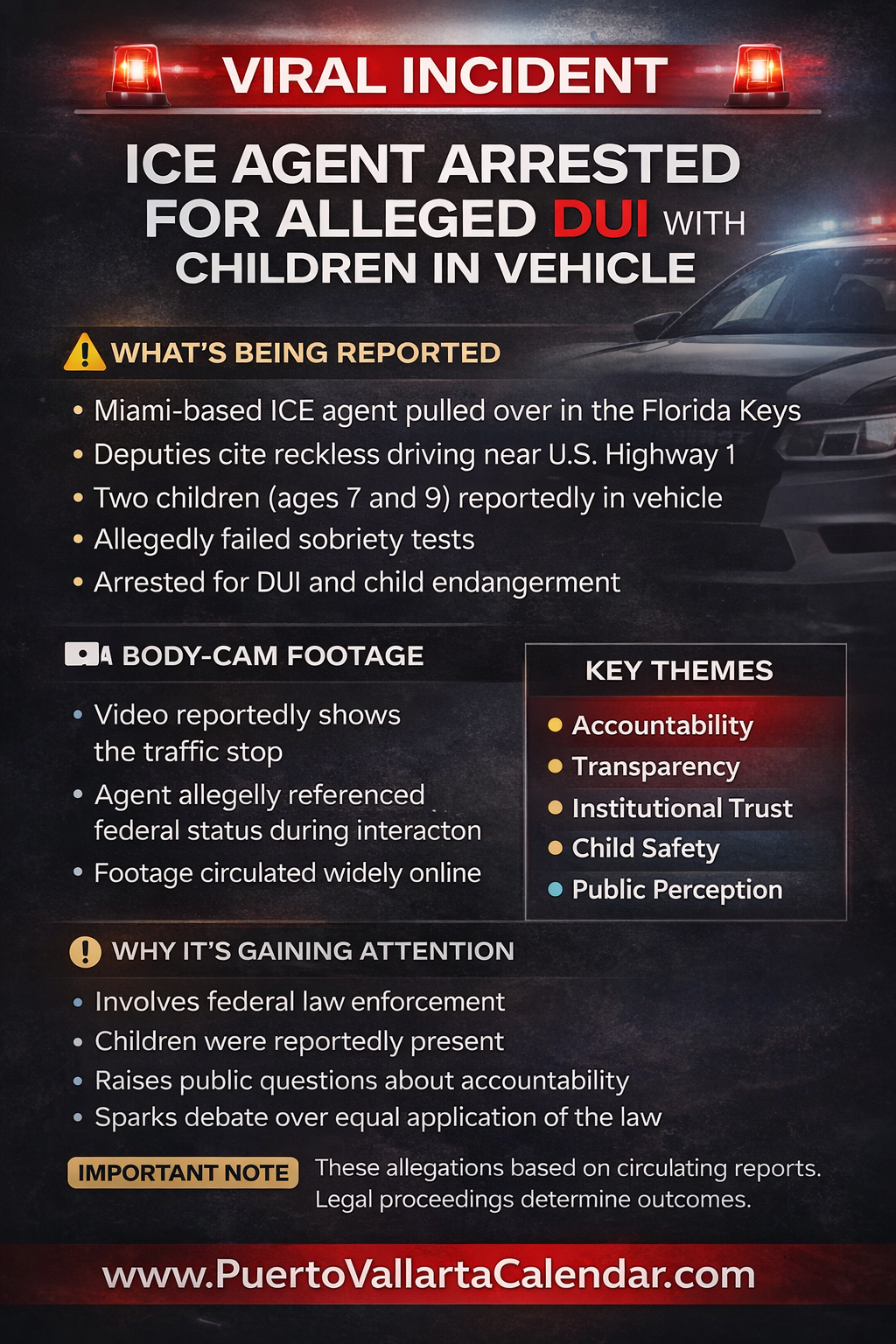
Over the past few days, a story has been circulating widely online: a Miami-based ICE agent allegedly arrested for driving under the influence with his two young children in the vehicle. According to reports referenced in viral posts, deputies in the Florida Keys pulled him over after observing reckless driving near U.S. Highway 1 by the Seven Mile Bridge. Authorities say he failed sobriety tests and was arrested on charges including DUI and child endangerment.
Then the body-cam footage surfaced.
And that’s when the conversation exploded.
Let’s break down what’s being reported — and why this story has sparked such a strong reaction.
What’s Being Alleged
Based on circulating reports and summaries shared online:
• A Miami-based ICE agent was pulled over in the Florida Keys
• Deputies cited reckless driving
• His two children, ages 7 and 9, were reportedly in the vehicle
• He allegedly failed field sobriety tests
• He was arrested for DUI and child endangerment
• Body-cam footage reportedly shows him referencing his federal status during the stop
It’s important to be clear: these are allegations. Charges are not convictions, and due process exists for a reason. Legal proceedings will ultimately determine the outcome.
Still, the optics of the situation are powerful — and that’s what has fueled the public reaction.
Why This Story Went Viral
DUI arrests happen every day. Sadly, so does child endangerment. On its own, that’s already serious.
But when the person involved reportedly works in federal law enforcement — specifically immigration enforcement — the story takes on a different weight.
The viral response isn’t just about the alleged DUI.
It’s about accountability.
According to online commentary, what intensified the backlash was the reported attempt to reference federal authority during the stop. Whether that moment was interpreted as intimidation, explanation, or something else, it struck a nerve.
Because when someone tasked with enforcing the law appears to invoke their position during a criminal stop, the public inevitably asks: do the rules apply equally?
The Accountability Conversation
This is where the incident becomes larger than one individual.
Public trust in institutions depends on consistency.
If agencies hold communities to strict legal standards, especially in matters related to immigration and public safety, then the expectation is clear: those same standards must apply internally.
No exceptions.
No preferential treatment.
No hierarchy of consequences.
Once people believe that the law bends depending on who you are or what badge you carry, confidence erodes quickly. And rebuilding that trust is far harder than protecting it in the first place.
The Impact of Body-Cam Footage
Body cameras were introduced to increase transparency. In this case, that transparency accelerated public scrutiny.
Video changes everything.
It allows the public to see tone, body language, context — not just read about it in a report. And in the age of social media, that footage doesn’t stay local for long.
Clips spread. Commentary follows. Narratives form almost instantly.
Whether someone views the footage as damning, misunderstood, or somewhere in between, the presence of video ensures the story won’t quietly fade away.
The Most Serious Element: The Children
Beyond the institutional questions, there’s a deeply human element here.
Two children were reportedly in the vehicle.
Driving under the influence is dangerous under any circumstance. When minors are involved, the emotional weight of the story increases dramatically.
For many people reacting online, this isn’t political. It’s parental.
It’s about safety.
And that’s often where public outrage becomes less ideological and more visceral.
What Happens Next
The next steps will play out through the legal system.
If the charges proceed, there will be court hearings, evidence presented, and a legal defense. Federal agencies typically conduct internal reviews when employees face criminal allegations, which can include administrative leave or disciplinary measures depending on the findings.
The public will likely continue watching.
Because when someone associated with federal enforcement faces allegations of this magnitude, the expectation of transparency grows.
The Bigger Picture
Stories like this resonate because they sit at the intersection of:
• Law enforcement authority
• Public accountability
• Institutional trust
• Child safety
• Equal application of the law
It’s not simply a DUI headline.
It’s a test of whether accountability is universal or conditional.
You don’t have to be politically aligned one way or another to care about that question. Believing in equal application of the law isn’t anti-law enforcement. It’s pro-integrity.
And in a time when public trust is fragile, consistency matters more than ever.
The legal process will determine the facts and the consequences.
But the broader conversation — about power, responsibility, and equal justice — is already underway.
Written by The Media King – Will Walker | @WNWalker