Who Really Benefited from the Capture of “El Mencho”? The Timing, the Politics, and the Power Play Behind the Latest Blow to Organized Crime in Mexico

Who Really Benefited? Or Did the Headlines Decide That for Us?
Sometimes the story isn’t the arrest.
It’s the framing.
When news broke about the capture of “El Mencho,” the immediate reaction wasn’t just about law enforcement, security policy, or long-term strategy. It was about optics. About headlines. About perception. And in 2025, perception travels faster than facts ever will.
So instead of asking who orchestrated what behind closed doors, maybe the more relevant question is this:
Who controlled the narrative?
Because that’s where the real power sits.
The Timing Narrative
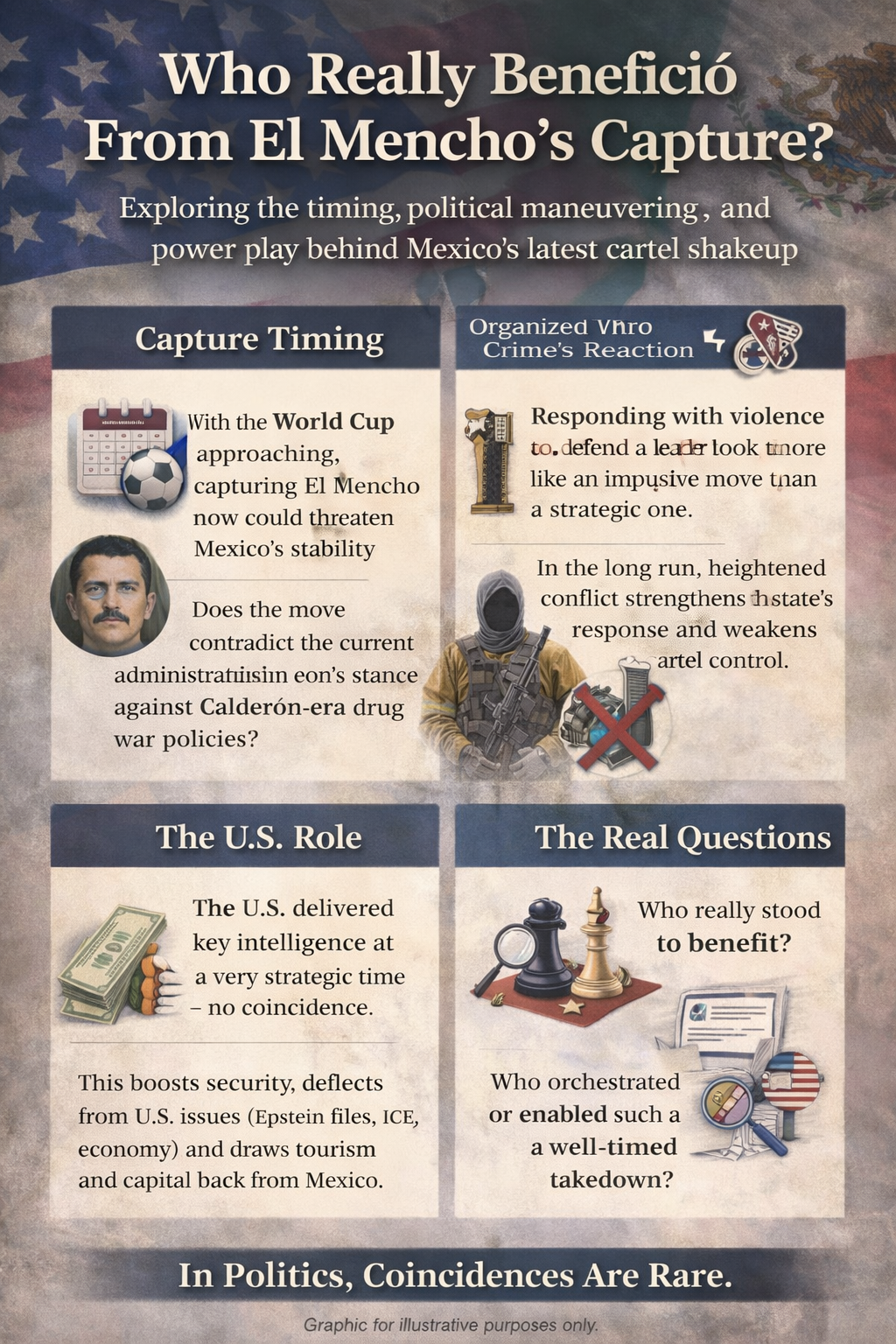
We’re heading toward a World Cup. A global stage. Billions watching. Every country wants to project stability, strength, and control. So when a high-profile arrest happens in this window, media outlets don’t just report it. They frame it.
Some headlines lean into strength. “Government Delivers Major Blow to Cartel.” Others highlight instability. “Violence Erupts Following Capture.” Same event. Completely different emotional takeaway.
That’s not accidental.
Media narratives shape investor confidence, tourism confidence, and public morale. The timing becomes less about strategy on the ground and more about how the story lands internationally.
And let’s be honest… perception affects economies.
The Violence Frame
Then came the response.
Organized crime reacting with visible violence. On the surface, that seems like a show of force. But through a media lens? It can look chaotic. Impulsive. Destabilizing.
And that matters.
Because when images of burning vehicles and armed figures circulate globally, they don’t just send a message to rivals. They send a message to tourists. To investors. To international audiences who don’t follow the nuance — only the visuals.
The State appears reactive or decisive depending on the framing.
The cartels appear powerful or desperate depending on the framing.
The camera decides.
The U.S. Angle and Narrative Contrast
Now let’s talk about contrast. Because international perception often operates on comparison.
If one country is framed as unstable, another can be framed as safer by default. If intelligence cooperation is highlighted, it can reinforce narratives of partnership and leadership. If internal U.S. issues are quietly sidelined in favor of a “strong security cooperation” storyline, that’s not necessarily conspiracy. That’s media prioritization.
And media prioritization influences public attention.
In today’s news cycle, attention is currency.
Governments understand this. So do media outlets. So do markets.
Reputation Is a Strategic Asset
Here’s the part people don’t talk about enough: modern geopolitics runs heavily on reputation management.
Safety perception affects tourism flows.
Stability perception affects capital movement.
Strength perception affects political capital.
You don’t need secret orchestration to understand that every major event becomes part of a larger narrative ecosystem. Communications teams respond quickly. Messaging gets aligned. Press releases get polished. Talking points get distributed.
That’s not sinister. That’s standard.
The Public Isn’t Just Watching. They’re Interpreting.
The real question might not be “Who benefited?” but “Who interpreted it first?”
Was it framed as proof that the government is regaining control?
Was it framed as evidence that instability still dominates?
Was it framed internationally as a contrast point?
Once a dominant narrative takes hold, it shapes how subsequent information is processed. Confirmation bias kicks in. Audiences see what aligns with the version they already accepted.
That’s the power of narrative momentum.
Reclaiming Power vs. Managing Optics
Let’s be clear about something: reclaiming public and governmental authority from criminal organizations is necessary. That’s not controversial.
What is worth examining is how those actions are communicated. Because in 2025, operations don’t exist in isolation. They exist inside a 24/7 media environment where every move becomes content.
And content becomes perception.
And perception becomes reality for millions of people who will never see the ground truth firsthand.
Very Few Stories Are Just Stories
In politics, few events are isolated. But not because of hidden puppet masters in dark rooms.
It’s because information ecosystems are strategic battlefields.
Every government understands messaging.
Every media outlet understands engagement.
Every political actor understands narrative leverage.
That doesn’t mean everything is orchestrated. It means everything is interpreted.
So maybe the sharper lens isn’t asking who pulled the strings.
Maybe it’s asking who shaped the headline.
Because in modern politics, the headline often matters more than the operation itself.
And once the story is told, it’s nearly impossible to untell it.
Written by The Media King – Will Walker | @WNWalker